Culminating reflection: Take a moment to reflect on organizational theory and leadership presented throughout this course. What is one or two takeaways that you believe will be valuable to you in a leadership role?
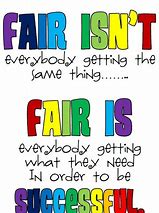
In reflecting over my past year as a Cal State Fullerton (CSF) student, one principle tenet that has resoundately soundly with me has been the college’s guiding goal of Just, Equitable, and Inclusive Education (JEIE). Specifically, CSF articulates that: “A just, equitable, and inclusive education requires an awareness of and willingness to interrupt and change policies and practices that have historically institutionalized the privileging of one group of students over others. ” As a future administrator in the field of education, that is such a profound concept to internalize into my leadership practices and priorities moving forward, particularly with respect to my past teaching experiences in a prison setting. To not do so would be almost negligent towards promoting positive outcomes for ALL students. More specifically I have understood the difference between the two terms of “equality” versus “equity” and how they affect education. Students need equity, not equality from their teachers, administrators, and schools. This is a valuable takeaway from my past year in my courses at CSF.
In this course specifically, EDAD 503: Organizational Leadership & Management A, I have learned the historic roots of management and leadership, the founders, and inherently what works and why in organizations. Also, I have understood that management and leadership are two entirely different entities. Frederick Taylor, whom is considered the father of scientific management, describes operational procedure in which workers are treated like machinery. Efficiency, maximum returns, and profits are prioritized. Leadership, in contrast, supports the human relations movement in which performance is determined by worker needs that directly correlate to behavior. Here, Elton Mayo is the founding father and he argued that a failure to promote the human condition did not realize optimal results. I found the Hawthorne study to be very interesting with respect to differentiating between the two. In 1928 the Western Electric Company near Chicago asked the question: “Does room lighting affect productivity?” (Marion & Gonzales, 2014). And in fact, it did. Productivity increased dramatically. This experiment holds great merit for student outcomes and is not to be underestimated in its relevance to education.
These two theories fuse (at least in my mind) to produce structural-functionalism. This practice is a duality of both the formal, task-oriented and the informal, personal side of organizational operation. Without knowing it initially, it is how I run my prison classroom and I believe it is why it runs so well. Nature and nuture combine to produce optimum student outcomes. The supervisors that I have had to date in prison are either task or personal-oriented, but never both and honsetly I believe this leads to an ineffective administrator. Both are very necessary in educational administration to be a successful leader.
Lastly, I understand the distinction between closed- and open- systems. My experience in prison has taught me that there really is no other system to consider with students in education that an open-system. So many of the inmates assigned to my classroom are products of failed home lives: abuse, divorce, drugs, guns, poverty, teenage pregnancy, and violence. As Marion & Gonzales aptly state: “Systems (or students) do not act in a vacuum; they do not control their own destines. They are products of their environments” (2014). We can only build capacity by understanding the holistic student.
 Sierra’s Blog