How do you define the difference between leadership and management? What do you believe are some of the functions of leadership? What are some examples of effective (or ineffective) leadership from your personal or professional experiences?
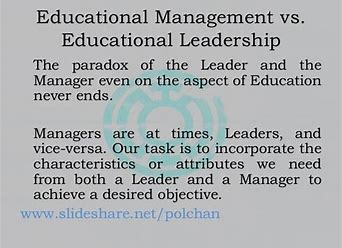
Leadership and Management are not mutually exclusive. There does not have to be a juxtaposition between the two. In fact, the two correctly instituted, can have complementary effects on each other. I would even argue that it is necessary to find a harmonious balance between the t be an effective leader in education. In a school, as an administrator, one cannot lead without management too. But how do you harmoniously unite the two?
Leadership is the ability to lead others by example and expression. It is not enough; however, to merely lead in name alone. There must be an authentic and intrinsic quality to the leader in order for others to emulate and follow their example. “Often we confuse management with leadership; we call principals or deans our leaders without considering whether they do indeed exhibit leadership behaviors” (Marion & Gonzales, 2014). In terms of data there is a qualitative feel to leadership. Leadership evokes influence and change.
Whereas management is focused on efficiency and rate of return. “Management is about standardizing procedures in order to draw maximum profits (read: test scores) from the organization; that is, it exploits the available human and physical resources to maximize returns” (Marion & Gonzales, 2014). Data-wise, management has a quantitative feel. Numbers and statistics determine changes and outcomes. It has an impersonal feel.
Again, I return to the ideology that both leadership and management can coexist in education and work together in a mutualistic relationship. Functionally, in order to be a good leader, you also need to be an effective manager. For instance, Henri Fayol, the French industrialist, cited five basic functions of management in his book. They include: “planning, organization, command, coordination, and control” (Marion & Gonzales, 2014). These are all necessary in educational classrooms. Teachers must plan and organize lessons, they must command their students through use of classroom management, they must coordinate with other staff in professional learning communities (PLCs) and with their peers and parents, and they must maintain order and control of their students using classroom management. Through comprehensive and effective management teachers are then able to teach and lead classrooms. For example: I write quotes on the board to inspire. My classroom is a safe place to learn where others are not disparaged and I have led by example to create a culture in my classroom that encourages personal responsibility and growth. I have integrity and I am passionate about my work. And I am innovative in my ideas. These are all functions of leadership.
My children’s former principal is an example of an effective leader. At the helm of a low-income, Title 1 school she reached out to the local community members and created a program of volunteer seniors who created a garden on campus. The seniors also sat in the hallways and practiced reading with English language learners. The seniors donated backpacks and markers to the students at the beginning of the school year. Through these coordinated efforts as well as creating an ELA rotation program in school, the school and its students substantially improved their standardized state test scores in reading. This example shows her ability to inspire, her commitment to the school as well as her delegation and empowerment of the community to shoulder up its local school.
 Sierra’s Blog